

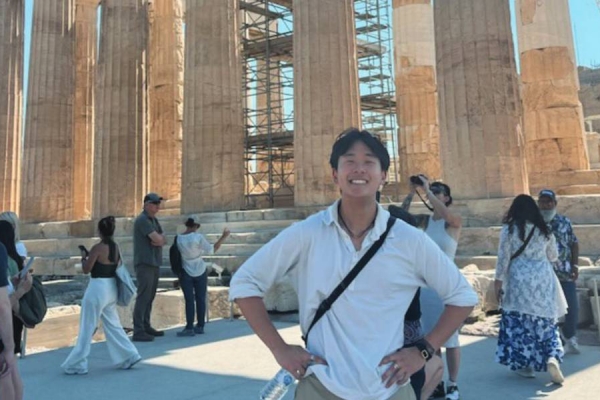
by Theodore Kim
I’ve been living in central Athens for four weeks now. I love being a tourist. I know some other tourists do their best to distance themselves from the label, but I embrace it – unapologetically taking photos on every street, constantly backtracking, being perpetually lost. I’m not a local by any means, and that’s okay. These first few weeks have been a chance to explore Athens, and I’d like to share a few of my favorite experiences so far.
Last week I took a day trip to Lake Vouliagmeni and the unnamed beaches that line the coast in that area. We ventured to a bus stop in the middle of a crowded highway, traversed down a steep rock face (and later learned there was a staircase), and came across a cove that could’ve been a postcard. Everyone was enjoying the good weather in some way, suntanning on rocks or swimming and I’m convinced that every Greek is an expert at diving. The Mediterranean Sea was so inviting, so turquoise and clear that I could never tell how deep it went. I left with a sunburn that I’m reassuring myself will turn into a tan. Exhausted, potentially cancerous and packed shoulder to shoulder on the 115 bus back, I had never felt better.
“Greek Time” is something I’ve learned to adopt while living here: being late is expected, an early workday might start at one in the afternoon, and some shops and restaurants will close simply because the owner feels like it. Time is flexible here. I think it’s part of Greek culture – to be guided by the elements, not by a strict schedule. Homes are built around open-air atriums to keep them cool; restaurants always offer outdoor seating, even on the hottest days. It’s not only the external elements, but internal ones that dictate Greek culture too. Eat when you’re hungry, take a break when needed, clap when you hear music playing on the street. The other day, a man trying to sell me jewelry stopped me to get my attention. I told him I was in a rush and had to leave. He placed a hand on my shoulder (Greeks are very affectionate) and said, “Please. You are in panic. Slow down” Athens isn’t a slow city, but it is one where people take their time.

If there’s any place in Athens that’s captured my heart, it’s Areopagus Hill. My roommate and I stumbled upon it while walking back from Plaka one night. Despite Google Maps claiming it was “temporarily closed” (how can you close a hill?), a crowd had already gathered there. The hill overlooks the entire city all the way to Piraeus port, and on the other side the Acropolis is lit by orange floodlights. The view of the sunset is clear and vibrant and every visitor takes their place on one of the many rocks that make up Areopagus Hill. It feels what the Ancient Athenian scholars would’ve wanted: people sitting on rocks, talking. I’ve returned a few times since and met countless Athenians and tourists who are quick to start conversation. Each night I’ve been, as the sun finally set on the horizon, the crowd would erupt in applause and cheers.
It reminded me of a scene from the final chapter of Kazuo Ishiguro’s “Remains of the Day”. Evidently, they had all paused a moment for the lights coming on, and then proceeded to fall into conversation with one another. As I watch them now, they are laughing together merrily. It is curious how people can build such warmth among themselves so swiftly. It is possible these particular persons are simply united by the anticipation of the evening ahead.
And the evening is a particularly special time for Athenians. The summer is long, and the days are too hot, so when the sun finally sets, the city begins to breathe. Dinners are held late enough that they fold into the night, and the city feels like it doesn’t sleep. The other night, while having dinner by Monastiraki square, the restaurant I was eating at turned into what felt like an impromptu mini-“πανηγύρι”. People stood on tables cheering, men and women of all ages danced together, the patrons that were too old to partake waved their napkins in the air as if they were their own dance partners.

A lot of the allure of travelling to Athens is its Ancient History, though I think the real beauty of Athens is there is so much contemporary Greek life occurring in this present moment: being lived under the backdrop of metro cars dressed in graffiti and unapologetic drivers, in the late-night conversations at the taverna, in the techno music heard on the streets of Exarcheia, in the endless hand gestures that make up a conversation when you don’t share a language. Athens' history is constantly being written and I’m glad I get to experience it.
*Theodore Kim is a Princeton University student from Korea, doing a summer internship in Athens.