

by Katerina Kamposou / Photos: Tasos Anestis
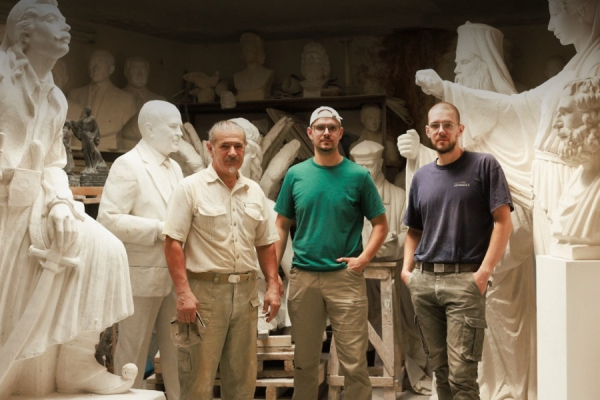
In Mets, amid cafés reborn as bars and apartment blocks replacing old family homes, one sound still echoes from another era: the rhythmic tapping of marble being carved. Inside the Georgiou family workshop, three generations continue to transform stone into art, carrying forward the patience, precision, and reverence that marble demands.
It was the cadence of the chisel that drew me inside the atelier—where, since 1950, knowledge has passed from grandfather to son, and from son to grandsons. And while the neighborhood evolves, the Georgiou workshop has become a destination again, this time for tourists, students, and anyone searching for a glimpse of authentic old Athens.
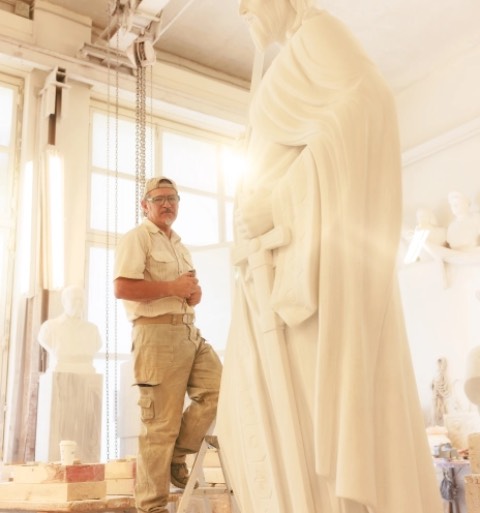
“My father, Giannis, found himself around 1950 in the workshop of a great sculptor, Evridias Lampaditis from Tinos,” explains Nikos Georgiou. “He became one of the most renowned portrait sculptors of his time. When his teacher retired, he handed him the workshop—where we still are today. As a child, I couldn’t understand how a rock could become a human figure. My first memory is watching my father work on a statue. I picked up a hammer to mimic him. Luckily, I didn’t damage anything—but that was my first encounter with the material. Curiosity became concern, then passion. At fifteen, I attended night school so I could work here during the day. Marble felt like the only path for me.”
Many marble craftsmen trained in this very space—some later working on the restoration of the Acropolis monuments.
“Marble doesn’t forgive. Depending on how you strike it, it can feel like iron—or butter,” Nikos says. “You must converse with it, not fight it. We work with the best marble in the world, Pentelic marble. Rare, expensive, but it’s our blessing to be close to it. Just look at what’s been created with it—the Parthenon itself—and the mountain is only an hour from here.”
Around the studio, I spot a reconstruction of the Nike of Marathon, “Greece crowning the Greek fighter,” the statue of a benefactor from Atsipopoulo in Crete, and a bust of actress Nonika Galinea, who posed in person. When I ask him to choose a favorite, he hesitates.
“They’re all my children,” he smiles. “But if I had to choose, it would be my first monumental work, ‘Freedom,’ holding the flame of liberty. It was placed in Kalamata, and it gave me the confidence to take on large-scale sculptures.”
How was the neighborhood 40 years ago compared to today?
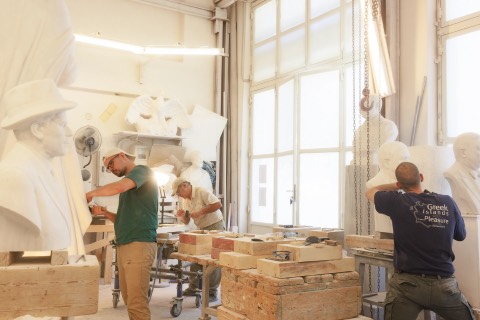
“The character has changed. Back then, Anapafseos Street had many marble workshops working the traditional way. I remember the rhythmic hammers—many sculptors working at once. It sounded like music. That’s gone now. But it’s still a neighborhood, beloved by artists—musicians, architects, painters. People greet each other. There’s warmth.”
Today, Nikos’s sons, Alexandros and Thanasis—graduates of the Athens School of Fine Arts—continue the craft. Most young sculptors, they say, avoid marble because of its difficulty and the years of devotion it requires. But in an age obsessed with speed, they insist on a romantic, old-school approach: no electric tools, only hammer and chisel, with Praxiteles, Michelangelo, Chalepas, and Rodin as their references.
“To make a statue, you don’t start with marble. First there’s clay, then a plaster mold, then the transfer to marble,” they explain. “Each stage has its secrets. During Covid, we worked nonstop and created the ‘Glory of Psara’—five tons of solid marble. When we finished, it was transported and installed at the island’s port.”
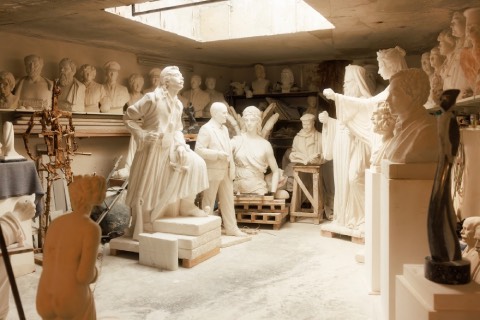
A bust requires about one and a half months for the model and another two months for the marble. A life-size statue takes a year. Recently, their slow and steady craft has gone viral. Visitors who discover the workshop through Airbnb Experiences share photos and videos across social media, bringing unexpected global attention to an art often described as “dying.”
“We always wanted to open the workshop to the world—without losing who we are,” Alexandros says. “Tourists walk in and are amazed. They say it’s the highlight of their trip, something they’ve never seen before. Even the shy ones leave smiling. Many write that we’re one of the most authentic experiences in Europe. That means everything to us. And at the end, we give them the marble piece they carved—a piece of Greece to take home.”
Some believe the future of sculpture lies in the digital sphere—in works created by robots or 3D printing. Does that worry them?
“Not at all,” they say. “Anything handmade will hold unique value in a world dominated by machines. There will always be people who seek it. Those are the people we work for.”